

for chances to win brokerage fee coupons!
From now until 31 December 2026, customers trading HK stocks / US stocks / A shares through any securities trading channel of the Bank can get a scratch card for each transaction. Log onto Hang Seng Invest Express mobile app to scratch your card for a chance to win and use a brokerage fee coupon, get up to full brokerage fee waiver on your next trade. There is no limit on the number of coupons to be received!

a full brokerage fee waiver on your next order
Just follow 3 simple steps:



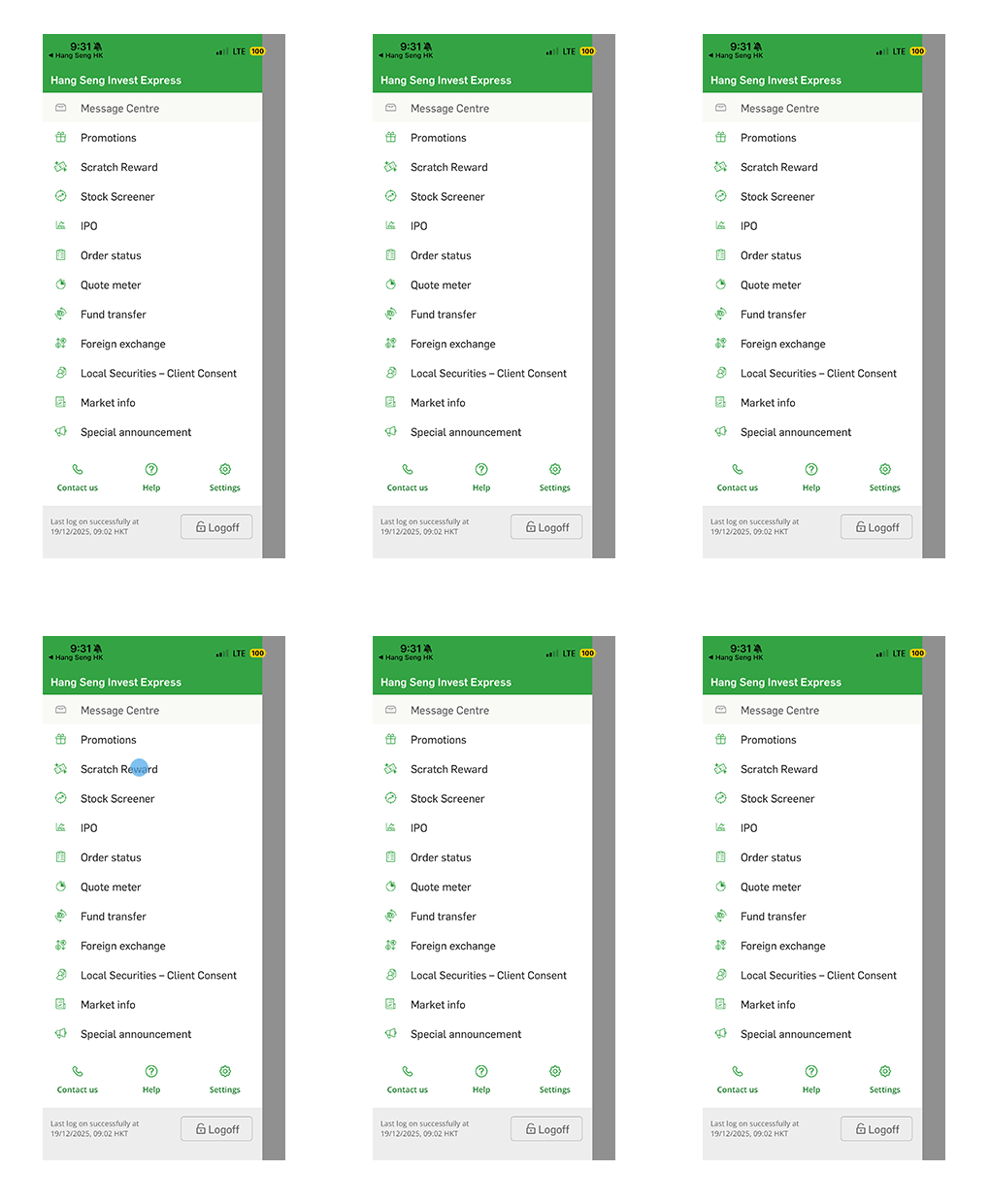







- For existing securities customers and young investors, the period to obtain scratch card(s) is from 1 September 2026 to 30 November 2026, and the brokerage fee coupon(s) will be automatically used during the period from 1 September 2026 to 31 December 2026.
- For new securities customers who open the securities account during the designated period, the period to obtain scratch card(s) is from the 4th to the 8th month after account opening, and the brokerage fee coupon(s) will be automatically used during the period from the 4th to the 9th month after account opening.
Illustrative Example (for reference only)
Assuming a customer purchased 500 shares at a price of HKD100 for Stock X through Invest Express. So, the total transaction amount is HKD50,000 and the standard brokerage fee (i.e. 0.25% of the transaction amount) is HKD125.
| Scenario | More than one Coupons available for this customer | More than one Coupons available for this customer | Coupon automatically selected for use in this transaction |
Net brokerage fee payable (i.e. after deduction of the coupon value) |
|---|---|---|---|---|
| 1 | Coupon A – $125 Coupon B – $100 |
$125 | Coupon A – $125 | $0 |
| 2 | Coupon C – $200 Coupon D – $150 |
$125 | Coupon D – $150* | $0 |
| 3 | Coupon E – $150 Coupon F – $100 |
$125 | Coupon F – $100 | Customer to pay $25 |
Important Risk Warnings
Risk Disclosure of Investment Funds
Investors should note that all investments involve risks (including the possibility of loss of the capital invested), prices or value of investment fund units may go up as well as down and past performance information presented is not indicative of future performance. Investors should read carefully and understand the relevant offering documents of the investment funds (including the fund details and full text of the risk factors stated therein) and the Notice to Customers for Fund Investing before making any investment decision. Investment funds are investment products and some may involve derivatives. Investors should carefully consider their own circumstances whether an investment is suitable for them in view of their own investment objectives, investment experience, preferred investment tenor, financial situation, risk tolerance abilities, tax implications and other needs, etc., and should understand the nature, terms and risks of the investment products. Investors should obtain independent professional advice if they have concerns about their investment.
Risk Disclosure of Equity Linked Investments ("ELIs")
- Equity Linked Investments ("ELIs") involve derivatives. You should not only base on this material alone to make any investment decisions. The investment decision is yours and you should not invest in ELIs unless the intermediary who sells it to you has explained to you that the product is suitable for you having regard to your financial situation, investment experience and investment objectives.
- ELIs are considered as a complex product and you should exercise caution in relation to ELIs. The market value of the ELIs may fluctuate and you may sustain a total loss of their investment. You should therefore ensure that you read and understand the nature of the ELIs and the relevant offering documents of the ELIs (including the full text of the risk factors therein) and, where necessary, seek independent professional advice, before making any investment decisions.
- Liquidity risk - ELIs are designed to be held to its maturity. You may not be able to sell your investment in the ELIs before maturity. If you try to sell the ELIs before maturity, the amount you receive may be substantially less than the investment amount.
- Credit risk of the ELI issuer - ELIs constitute general unsecured and unsubordinated contractual obligations of the issuer. When you buy ELIs, you will be relying on the creditworthiness of the ELI issuer and of no other person. You have no rights under the terms and conditions of ELIs against any issuer of any linked stock. If the relevant ELI issuer becomes insolvent or default on its obligations under the ELIs, in the worst case scenario, you could lose substantial part or all of the capital invested. ELIs may be terminated early by the Issuer.
- Some ELIs are partially capital protected at maturity provided that you hold the ELIs until maturity and the ELIs are not otherwise early terminated.
- Investing in ELIs is not the same as investing in the linked reference asset(s) directly.
- Not covered by the Investor Compensation Fund - ELIs are not traded on any markets operated by Hong Kong Exchanges and Clearing Limited or any other stock exchanges. There may not be an active or liquid secondary market.
- The above is not an exhaustive list of risk factors. For details, please refer to the offering documents.
Risk Disclosure of Structured Notes
- Structured notes involve derivatives. You should not only base on this material alone to make any investment decisions. The investment decision is yours and you should not invest in the product unless the intermediary who sells it to you has explained to you that the product is suitable for you having regard to your financial situation, investment experience and investment objectives and you fully understand and are willing to assume the risks associated with it.
- Structured notes are considered as a complex product and you should exercise caution in relation to Structured note. The market value of the structured notes may fluctuate and investors may sustain a total loss of their investment. You should therefore ensure that you read and understand the nature of structured notes and the relevant offering documents of the structured notes (including the full text of the risk factors therein) and, where necessary, seek independent professional advice, before making any investment decisions.
- Credit risk of the Issuer - structured notes constitute general unsecured and unsubordinated contractual obligations of the Issuer. When you buy structured notes, you will be relying on the creditworthiness of the Issuer and of no other person. You have no rights under the terms and conditions of the structured notes against any issuer of any linked underlying(s). If the Issuer becomes insolvent or default on its obligations under the product, in the worst case scenario, you could lose substantial part or all of the capital invested. The structured notes may be terminated early by the issuer.
- Some structured notes are 100% capital protected at maturity provided that it is not otherwise early terminated by the Issuer.
- Investing in structured notes are not the same as investing in the linked reference asset(s) directly.
- The structured notes are not normal time deposits, and they are not protected by the Deposit Protection Scheme in Hong Kong.
- Not covered by the Investor Compensation Fund – structured notes are not traded on any markets operated by Hong Kong Exchanges and Clearing Limited or any other stock exchanges. There may not be an active or liquid secondary market.
- The above is not an exhaustive list of risk factors. For details, please refer to the offering documents.
Risk Disclosure of Bonds
- Bonds are investment products. The investment decision is yours but you should not invest in a bond unless the intermediary who sells it to you has explained to you that the bond is suitable to you having regard to your financial situation, investment experience and investment objectives. Your intermediary is under a duty to assure that you understand the nature and risks of this product, and that you have sufficient net worth to be able to assume the risks and bear the potential losses of trading in this product.
- Bonds are not deposits and should not be treated as substitute for conventional time deposits.
- Bonds are not a protected deposit and is not protected by the Deposit Protection Scheme in Hong Kong.
- Investors who purchase bonds are exposed to the credit risk of the issuer and guarantor (if any) of the bonds. There is no assurance of protection against a default by the issuer/guarantor in respect of the repayment obligations. In the worst case scenario, any failure by the issuer and the guarantor (if any) to perform their respective obligations under the bonds when due may result in a total loss of all of your investment.
- Renminbi (RMB) is not a freely convertible currency. As such, investors trading bonds denominated in RMB are subject to additional risks (such as currency risk).
- The above is not an exhaustive list of risk factors. Please refer to the section on "Risk Factors" in the relevant "Bond Trading Services" Factsheet to understand other risk factors applicable to bonds.
- The information displayed does not constitute nor is it intended to be construed as any professional advice, offer, solicitation or recommendation to deal in Bonds. Investors should be aware that all investments involve risks (including the possibility of loss of the capital invested). The prices of Bonds may go up as well as down and past performance is not indicative of future performance. Investors should not only base on this information alone to make investment decisions, and should carefully consider whether an investment is suitable for them in view of their own investment objectives, investment experience, investment tenor, financial situation, risk tolerance abilities, tax implications and other needs, etc., and should read the relevant product offering documents and terms and conditions (including the full text of the risk factors therein) in detail before making any investment decisions. Investors should obtain independent professional advice if they have concerns about their investment.
- No guarantee, representation, warranty or undertaking, express or implied, is made as to the fairness, accuracy, timeliness, completeness or correctness of any general financial and market information, news services and market analysis, projections and/or opinions ("Market Information") provided above and the basis upon which any such Market Information have been made, and no liability or responsibility is accepted by the Bank in relation to the use of or reliance on any such Market Information whatsoever provided in the information.
- Investors must make their own assessment of the relevance, accuracy and adequacy of the information provided and make such independent research/investigations as they may consider necessary or appropriate for the purpose of such assessment. The Bank does not make any representation or recommendation or assessment as to whether or not any of the investment(s) mentioned are suitable or applicable to any persons and thus shall not be held responsible in this regard.
Risk of investing in securities via Stock Connect Northbound Trading
Investors should note that investing in different Renminbi-denominated securities and products involves different risks (including but are not limited to currency risk, exchange rate risk, credit risk of issuer / counterparty, interest rate risk, liquidity risk (where appropriate)). The key risks of investing in securities via the Stock Connect Northbound Trading include:
- Once the respective quota is used up, trading will be affected or will be suspended.
- Stock Connect Northbound Trading will only operate on days when both markets are open for trading. Investors should take note of the days the Stock Connect Northbound Trading is open for business and decide according to their own risk tolerance whether or not to take on the risk of price fluctuations in securities during the time when Stock Connect Northbound Trading is not trading.
- When a security is recalled from the scope of eligible securities for trading via Stock Connect Northbound Trading, that security can only be sold but NOT bought.
- Investors will be exposed to currency risk if conversion of the local currency into RMB is required.
Risk of investing in foreign securities
Foreign securities carry additional risks not generally associated with securities in the domestic market. The value or income (if any) of foreign securities may be more volatile and could be adversely affected by changes in many factors. Client assets received or held by the licensed or registered person outside Hong Kong are subject to the applicable laws and regulations of the relevant overseas jurisdiction which may be different from the Securities and Futures Ordinance (Cap.571) and the rules made thereunder. Consequently, such client assets may not enjoy the same protection as that conferred on client assets received or held in Hong Kong.
Risk of investing in Exchange Traded Fund ("ETF")
Investors should note that ETF is different from a typical unit trust and many factors will affect its performance. In general, the market price per ETF unit may be significantly higher or lower than its net asset value per unit due to market demand and supply, liquidity, and scale of trading spread in the secondary market and will fluctuate during the trading day. ETF is different from stocks, investors should read the offering documents of the relevant ETF and understand the features and risks of ETF etc.
RMB Currency Risk
Renminbi ("RMB") is subject to exchange rate risk. Fluctuation in the exchange rate of RMB may result in losses in the event that the customer subsequently converts RMB into another currency (including Hong Kong Dollars). Exchange controls imposed by the relevant authorities may also adversely affect the applicable exchange rate. RMB is currently not freely convertible and conversion of RMB may be subject to certain policy, regulatory requirements and/or restrictions (which are subject to changes from time to time without notice). The actual conversion arrangement will depend on the policy, regulatory requirements and/or restrictions prevailing at the relevant time.
Foreign Exchange Risk
Foreign Exchange involves Exchange Rate Risk. Fluctuations in the exchange rate of a foreign currency may result in gains or losses in the event that the customer converts HKD to foreign currency or vice versa.