We use cookies to give you the best possible experience on our website. By continuing to browse this site, you give consent for cookies to be used. For more details, please read our Online Terms & Conditions, Privacy Policy, Cookies Policy and Personal Information Collection Statement.
We recommend using a computer web browser or Hang Seng Mobile App to log on for enhanced security. Please visit "Security Information Centre" for more security tips.



Please read the Important Risk Warnings for FX2 - FX And Precious Metal Trading Services

FX2 - FX and Precious Metal Trading Services ("FX2") enables you to enter into a currency or precious metal contract with the expectation that its exchange rate / price against another will move in an anticipated direction.
Create open positions with deposits equivalent to 100% of the FX2 trading contract’s value. Regardless of market direction, make use of long-short strategies and benefit from a FX & Gold (XAU) entry threshold as low as HKD5,000.
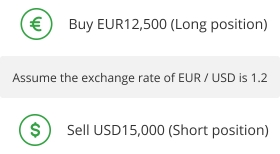
Mrs. Wang has deposited USD15,000 into her investment portfolio. She expects the exchange rate of EUR / USD to go up later.
| Investment details | |
|---|---|
| Currency pair | EUR / USD |
| Position details | Buy EUR, sell USD |
| Open EUR / USD exchange rate | 1.2 |
| Contract amount | EUR12,500 |
| Initial collateral level (%) | 100% of the value of the contract |
| Initial collateral (in USD or other equivalent currencies) | (EUR12,500 ✕ 100%) ✕ 1.2 = USD15,000 |
Mrs. Wang deposited USD15,000 into the FX2 collateral account for FX trading.

Collateral: USD15,000
Mrs. Wang holds a bullish view on EUR and has opened a long position of EUR / USD.
Mrs. Wang decided to square the position. A new opposite position is created to offset the existing one selected, i.e. selling EUR and buying USD.
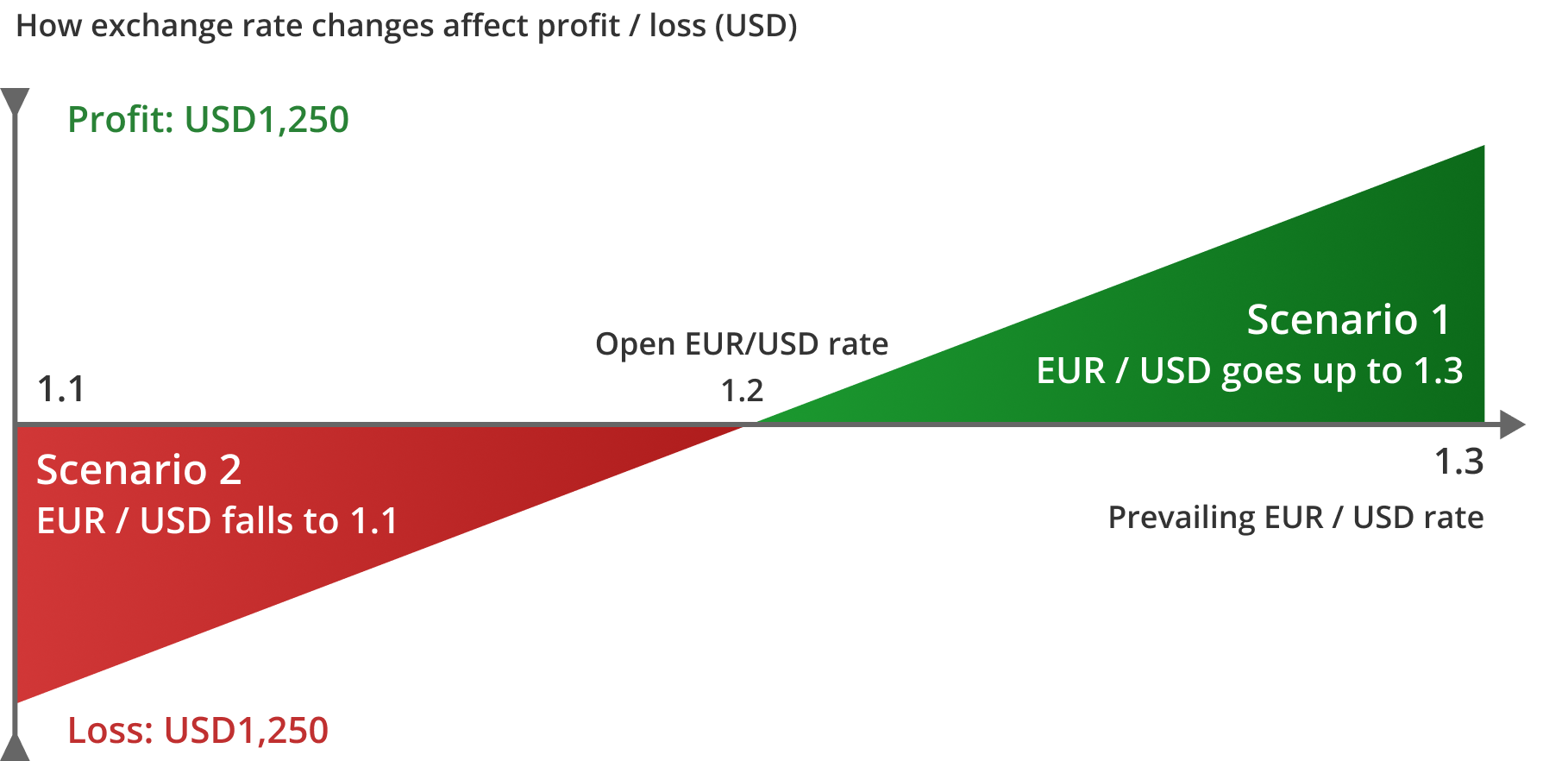
| Scenario | Profit / loss for day 2 (USD)[1][2] |
|---|---|
The exchange rate of EUR / USD goes up to 1.3 |
Profit: (1.3 - 1.2) ✕ EUR12,500 = USD 1,250 |
| The exchange rate of EUR / USD falls to 1.1 | Loss: (1.1 - 1.2) ✕ EUR12,500 = -USD 1,250 |
| The exchange rate of EUR / USD falls to 0.06, and the collateral level falls to 5% | Loss: (0.06 - 1.2) ✕ EUR12,500 = -USD14,250 Mrs. Wang has to deposit additional collateral to maintain the existing position |
| The exchange rate of EUR / USD falls to 0.036, and the collateral level falls to 3% | Loss: (0.036 - 1.2) ✕ EUR12,500 = -USD14,550 If Mrs Wang doesn't deposit the required collateral within the prescribed time, or if the settlement account remains a negative balance because of trading loss or rollover interest, the position may be closed out without prior notice / consent. |
Here's the amount of rollover interest Mrs. Wang can receive on day 2 (USD).
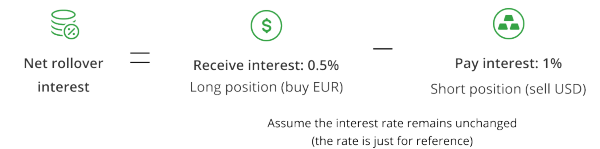
| Scenario | Rollover interest received on day 2 (USD)[3][4] |
|---|---|
| The exchange rate of EUR / USD goes up to 1.3 | [EUR12,500 ✕ 1.3 ✕ (0.5% p.a. ✕ 1 / 360)] - [EUR12,500 ✕ 1.2 ✕ (1% p.a. ✕ 1 / 360)] = -USD0.19 |
| The exchange rate of EUR / USD falls to 1.1 | [EUR12,500 ✕ 1.1 ✕ (0.5% p.a. ✕ 1 / 360)] - [EUR12,500 ✕ 1.2 ✕ (1% p.a. ✕ 1 / 360)] = -USD0.23 |
Interest for the collateral has not been included in this illustrative example.
Here's the total profit / loss Mrs. Wang can receive on day 2 (USD).

| Scenario | Total profit / loss on day 2 (USD) |
|---|---|
| The exchange rate of EUR / USD goes up to 1.3 | Total profit: USD1,250 - USD0.19 = USD1,249.81 |
| The exchange rate of EUR / USD falls to 1.1 | Total loss: - USD1,250 - USD0.23 = - USD1,250.23 |


FX2 Account Opening Guide
Generally, currency exchange refers to exchanging one currency for another according to the exchange rate. Similar to how we exchange foreign currency when we travel.
Take the currency pair EUR/ HKD as an example. If you plan to go to Europe and EUR strengthens to 10 against HKD, you can exchange EUR1,000 with HKD10,000. If EUR weakens to 8 against HKD, you can exchange EUR1,250 with HKD10,000. Therefore, if EUR depreciates against HKD, the cost of travelling will be relatively lower.
In addition, the fluctuations in exchange rates also affect investors' decisions. "Forex" or "FX" is a common abbreviation for foreign exchange, typically used to describe investors trading foreign exchange in the foreign exchange market. If you expect a currency to appreciate, you will purchase the currency. If you expect the currency to depreciate, you will sell the currency.
"Buy low, sell high" is therefore the common investing strategy of buying a currency when it is low, and selling it when it is high.
The FX market is comprised of multiple currency pairs in the global market. Unlike other markets, FX is quite decentralised - transactions occur globally across various markets. It’s very rare for currency pairs to maintain the same rate over an extended period of time.
In FX market, there are no restrictions when it comes to trading FX. You can buy (long) or sell (short) FX based on market conditions. Which means there’s no “Bear Market” – FX traders can earn profits (or suffer losses) regardless of which direction the market is headed.
FX trade is conducted during business hours around the globe. Therefore, investors can monitor and trade on the market 24 hours a day. With this trading flexibility, the time boundary no longer exists, meaning you can choose to start your trading hours after your office hours.
The FX market is the most liquid market in the global economy with daily settlement amounts reaching 4 trillion USD. The sheer size and volume of the FX market means each individual deal has miniscule effect on the market, hence ensuring market integrity and transparency.
The majority of the trades on the FX market use the major currencies (EUR, GBP, AUD, NZD, USD, CAD, CHF, and JPY), so investors can focus their market research on these currencies. Furthermore, almost all FX market-related news are announced to the public by governments or research institutions and is available almost instantaneously.
Let’s take an example. Mark is a professional investor. He borrows a currency with low interest (e.g. Currency A), to fund high-yield investments (e.g. Currency B) to have a carry trade. However, if there is market uncertainty and risk escalates, Mark will repay his loan with his investments to unwind his carry trade. Currency A will appreciate if it returns simultaneously (Currency B convert back to Currency A) if this pessimistic emotion throughout the market. Low-interest currencies are usually considered as Funding Currency.
When an event that can affect the global economy happens, Mark moves his capital into countries with a relatively stable economy, say Country / region C. Mark may purchase Currency C for reasons such as: Country / region C is a neutral country / region, with little or no political or economic issues. Hence Currency C may be less likely to rise or fall significantly in value. Relatively stable currencies are usually considered as safe haven currency.
Mark also likes to invest in commodity currency, meaning the particular country / region is an exporter of goods. Examples include Canada with mineral fuels, Australia with ores, New Zealand with agricultural products, etc. The respective countries’ currencies are closely related to the prices of their goods, and such is usually considered as Commodity Currency.
FX2 is a foreign currencies and precious metals trading tool offered by the Bank, which allows you to create long and short positions according to prevailing market situation. No physical delivery is involved. Here are the key features of FX2:
You can trade through various channels
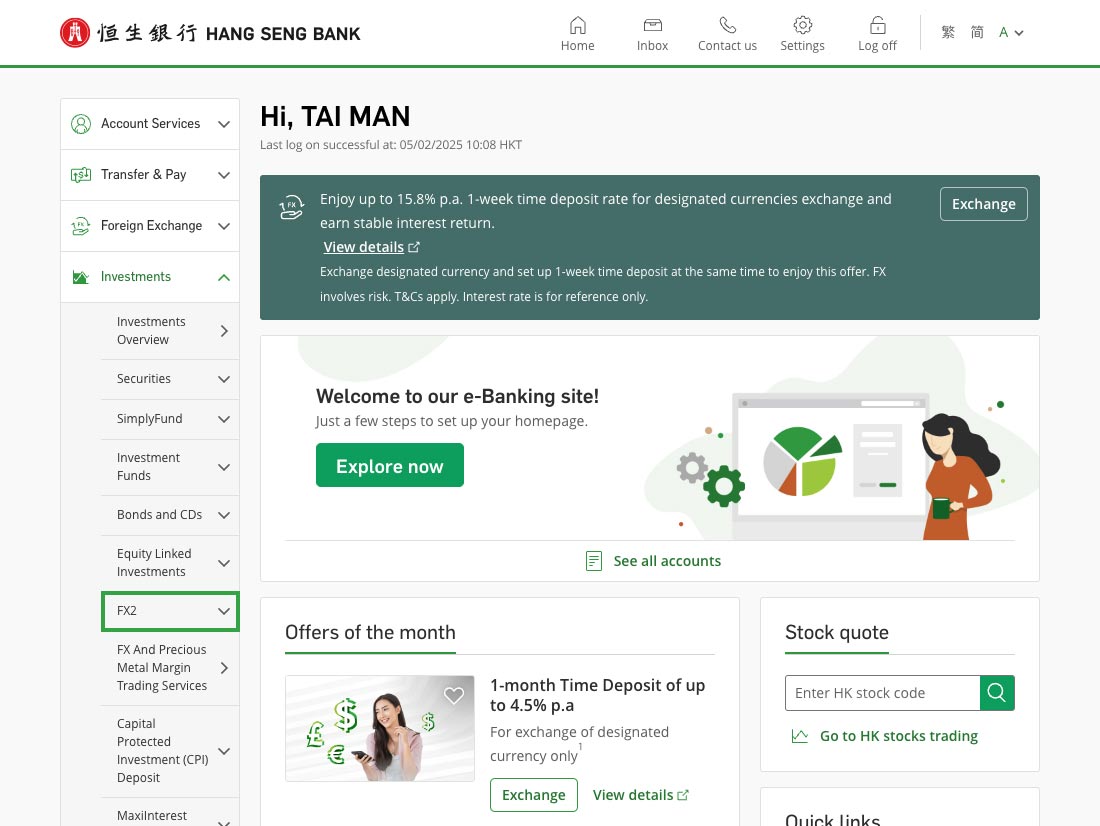
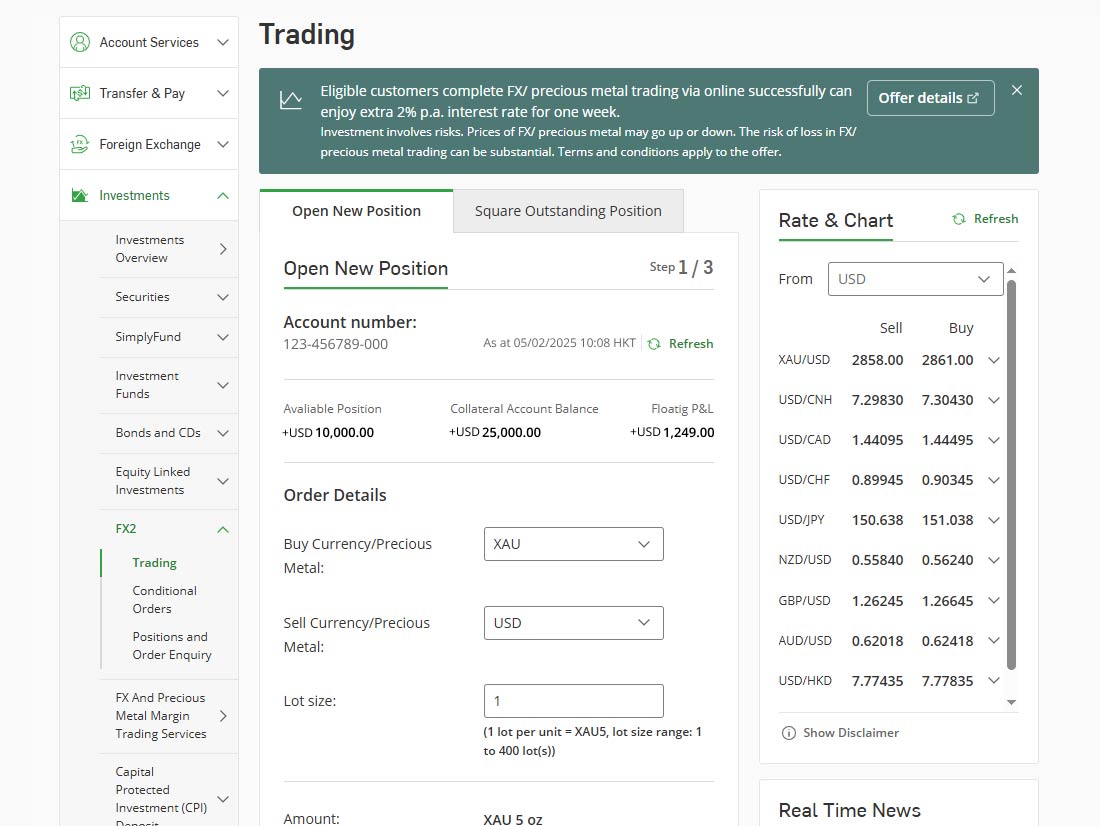
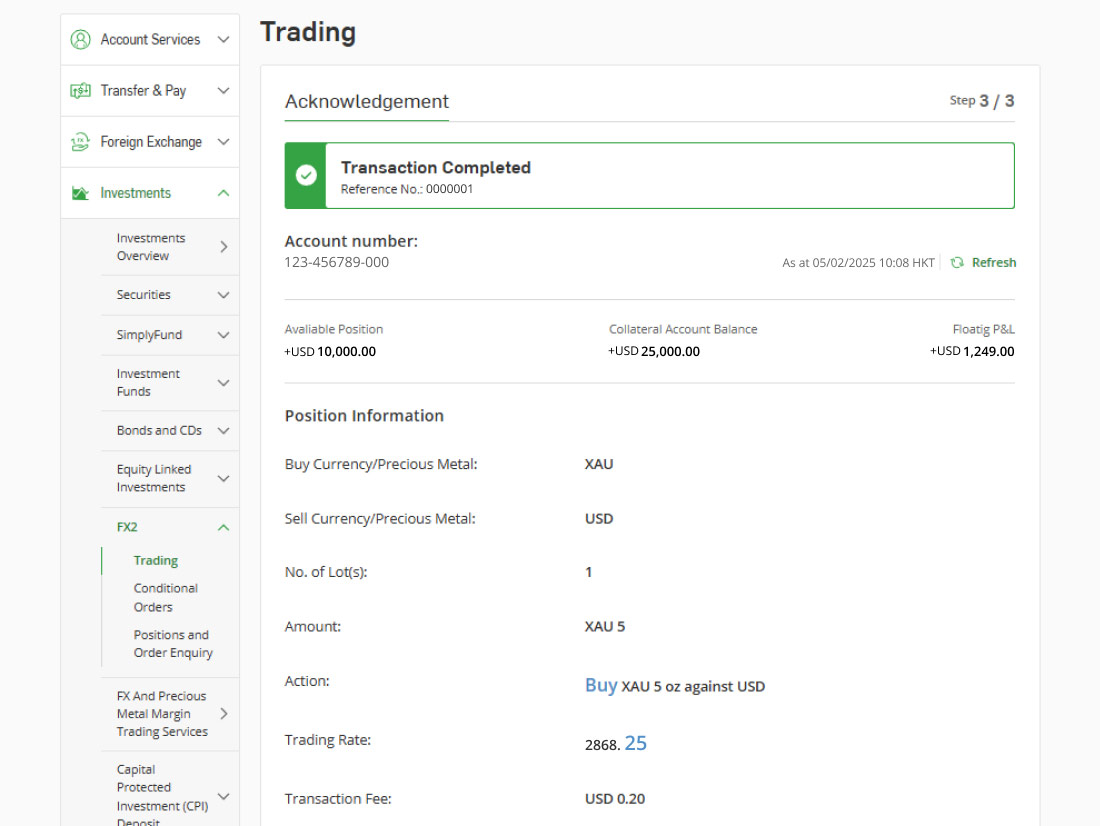
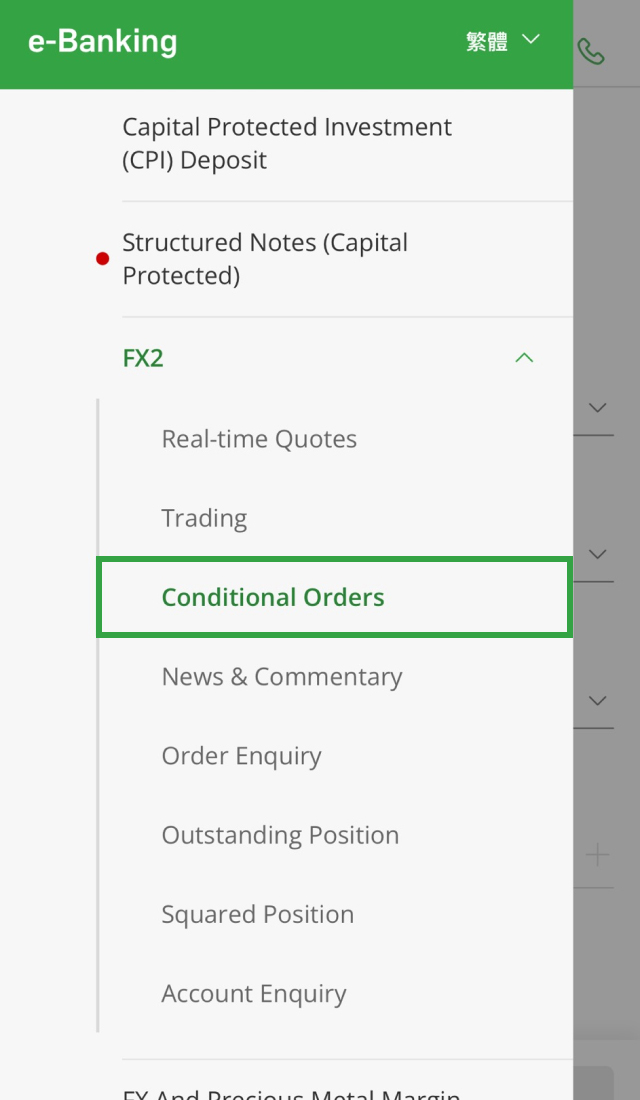
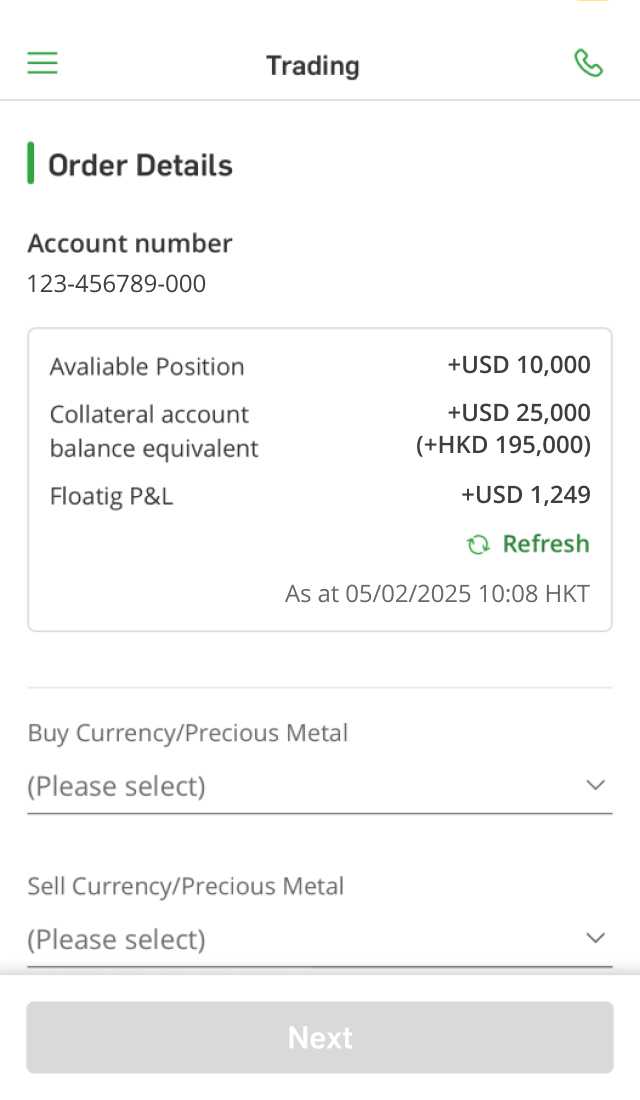
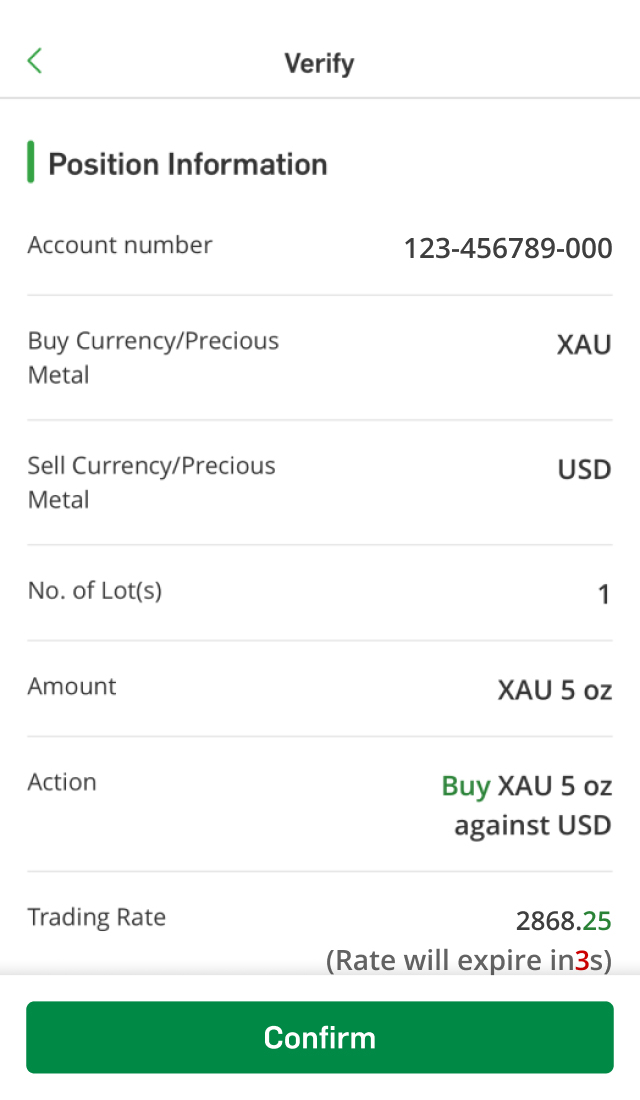
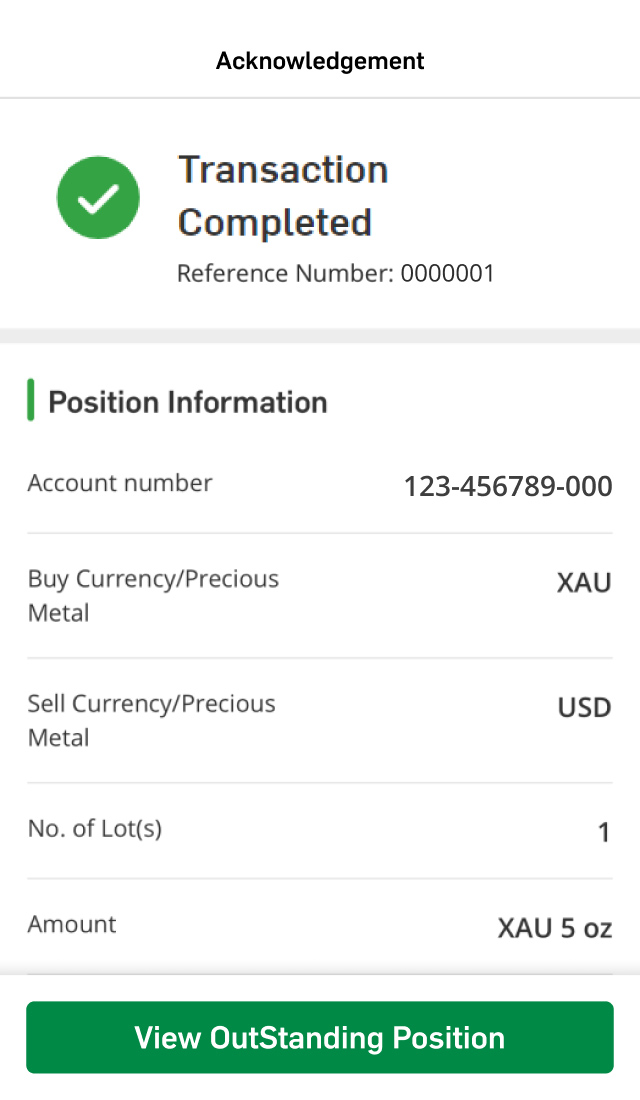
You can enquire real-time FX and precious metal quotes, buy / sell, place conditional orders, cancel & enquire conditional orders via Personal e-Banking or Hang Seng Mobile App. Also, you can check your outstanding positions, squared positions, transaction history and account information.
We provide real-time streaming FX and precious metal quote, global news, today’s focus and market commentary.
If you are a holder of Hang Seng Integrated Account, you may apply for a FX2 - FX and Precious Metal Trading Services Account via Personal e-Banking or by visiting any of our branches. You can refer to our Terms and Conditions, and Account Opening Guide under "Knowledge and insights" section on this page for more information.
If you are new or non-integrated account customer, you may open an integrated account and activate your investment account via Hang Seng Mobile App[9]. View more details at: https://www.hangseng.com/en-hk/personal/banking/account-opening/mobile/
Collateral Account is an account where you place collateral for FX and precious metal trading.
The following can be used as collateral:
You need to have sufficient collateral to create or maintain an open position by reference to the Top Up Collateral Level and/or the Close-out Collateral Level. You are reminded to monitor your collateral balance closely on an on-going basis.
Yes. You can square an outstanding position partially.
Whenever you intend to conduct a real-time buy / sell-trade or place a conditional order with us, you may choose to either
If you choose to “Square”, a new opposite position will be created which will be immediately used to set-off an existing position chosen by you.
You may enter into a squared position as long as there is an existing opposite position.
When your collateral level decreases to 3%, a Close-out event will be triggered. The outstanding currency or precious metal position with the largest floating loss will be closed out first.
You can reactive your account by logging on Personal e-Banking, then choose “Account Services” > “Other Related Services” > “Reactive Inactive/ Dormant Account”
Generally, trading hours are Hong Kong Time from Mon 6:00 a.m. to Sat 3:30 a.m. Actual service hours may vary due to the close of relevant FX or precious metal market on occasions such as holidays.
Yes. You may set up transfer order for HKD / foreign currency via Personal e-Banking, Hang Seng Mobile App during below service hours:
Deposit: Mon 6:00 a.m. to Sat 6:00 p.m.
Withdrawal: Mon 6:00 a.m. to Sat 3:30 p.m.
No. Your conditional orders will only be monitored and executed during trading hours.
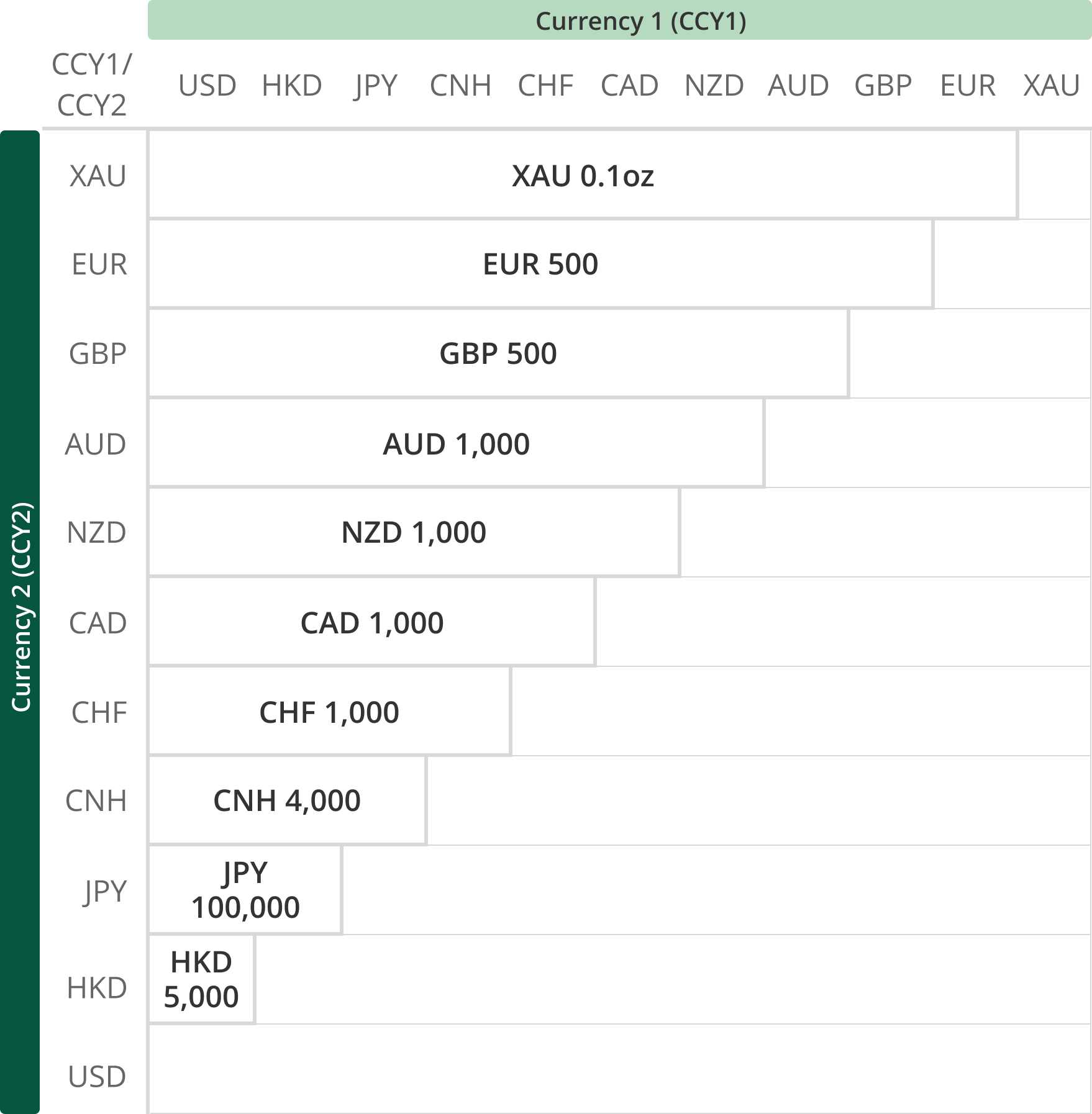
Below table summarizes the minimum transaction amount of each currency/precious metal.
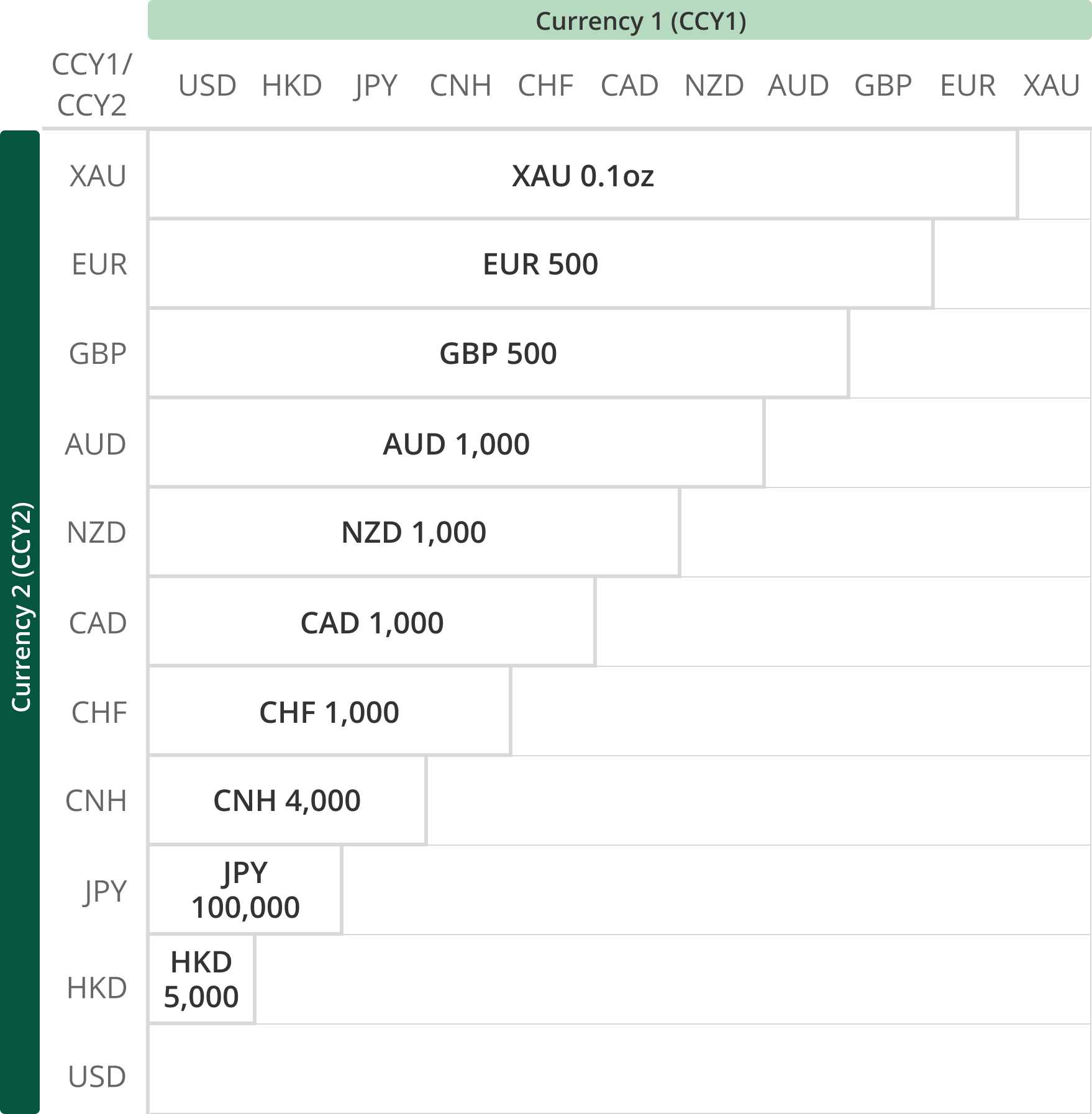
The trades and accrued interests will be settled in USD.
Spot rate is a price quoted for immediate settlement, while order rate is a rate within some pre-determined basis points of the spot rate under your choice.
There is no upper limit in number of currency / precious metal pairs to be placed in your watchlist.
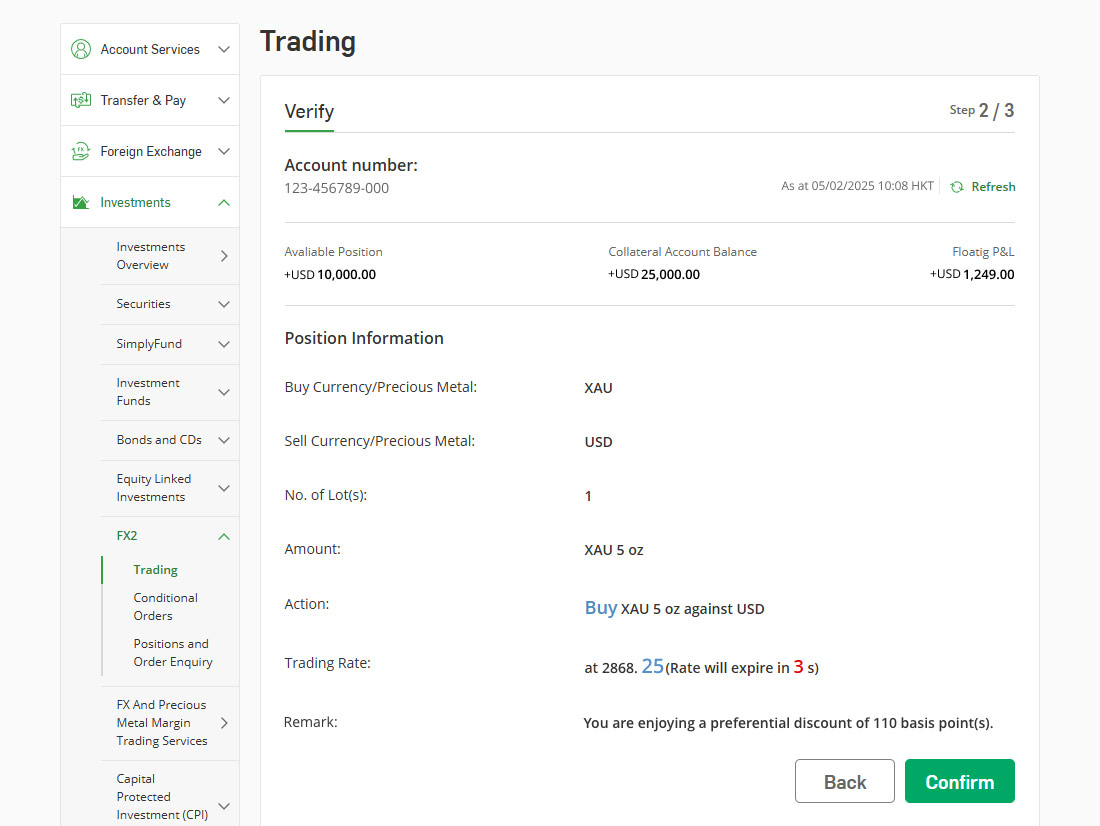
After entering the "Confirmation" page, the transaction price will be updated every 5 seconds.
No. Your relevant open-position conditional order will be cancelled automatically without notice when the market price reaches the order rate.
You have a choice of 4 types of worldwide conditional orders under the FX2 - FX and Precious Metal Trading Services
| Normal Order | To buy / sell at a pre-set price of exchange rate or precious metal price. |
| Either-Or Order | 2 normal orders are placed and if any of them is executed, the other will automatically be cancelled. |
| If-Then Order | 2 normal orders are placed but only when the first order (i.e. the “IF” leg) is executed, the second order (i.e. the “THEN” leg) will be activated. |
| 2-in-1 Order | A combination of an If-Then order and an Either-Or order, whereby the Either-Or order is the “Then” leg of the If-Then order. Only when the first order (i.e. the “IF” leg) is executed, the second order (i.e. the Either-Or order) will be activated, where upon if any normal order in the Either-Or order is executed, the other one will automatically be cancelled. |
Yes. There will be a separate monthly statement for the Account, unless you have no trading activity and no balance at the end of the month.
In addition to viewing all transactions during the day on the FX2 daily e-Advice, you can also log on to Personal e-Banking > "Investments" > "FX2" > "Positions and Orders Enquiry" > "Transaction History" tab, or go to the left menu of Hang Seng Mobile App > "Investments" > "FX2" > "Account Enquiry" > "Transaction History" tab to view transaction made up to 60 days.
What's more, you will receive monthly statement with details such as collateral level, collateral account balances, outstanding positions and transaction records.
The prevailing rate / price between open and square / close a position will affect the profit / loss. In addition, daily rollover interest will be accrued based on the currency/ precious metal you buy, whereas a daily rollover interest will be charged based on the currency / precious metal you sell in the outstanding position, according to the prevailing practice in the market. The interest accrued will be netted off against the interest charged, and affect your profit / loss.
Investment involves risks. The risks set out below cannot disclose all the risks involved. You should read and understand all the relevant product documents and risk disclosure statements before making any investment decision.
Investment involves risks. The risks set out below cannot disclose all the risks involved. You should read and understand all the relevant product documents and risk disclosure statements before making any investment decision.